|
Cover photo: Vasil Stanko
© 2003 Lotos Records. Available from cdmusic.cz
A fascinating, memorable disc that certainly merits investigation.
I would highly recommend this CD. The compositions are well crafted and interessting; the performances are excellent; and the production is good.
|
 HUDBABY
 Katerina Ruzickova: Romance for Grand Piano
|
Available from: © 2009 Radioservis (Czech Radio)
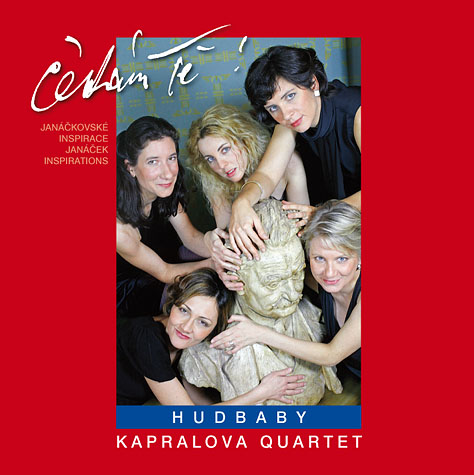
Cekam Te! Janackovske Inspirace (I Am Waiting for You! Janacek Inspirations)
If music for string quartet could ever be defined as hip, then the CD, Cekam Te! (I Am Waiting for You), would be the exemplary barometer of cool to which all others would aspire. From the CD’s thematic concept to the inclusion of mezzo-soprano, percussion, and string quartet instrumentation, this recording exudes stylish and thought-provoking music.
The CD features the compositions of Hudbaby (THE MUSICRONES), a group of young female composers. This group was formed in 1997 at the Janacek Academy of Music and Performing Arts in Brno, where the majority of the members had studied.
The central theme of this recording takes inspiration from one of Leoš Janacek’s miniatures from the 1928 piano cycle, The Album for Kamila Stosslova. The particular miniature used here is largely regarded by scholars to be Janacek’s last composition and further, the words “I am awaiting you!” were written in the score and were meant for Kamila, Janacek’s muse and love of the last decade of his life.
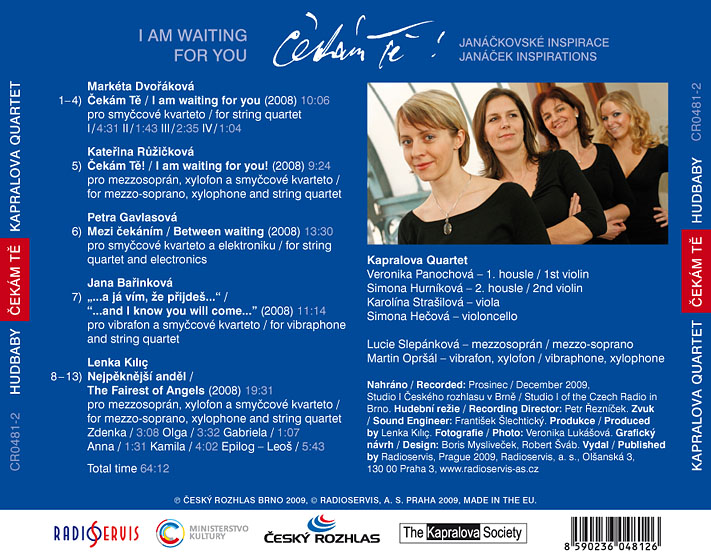
Hudbaby took inspiration from this very personal message from Janacek to Stosslova, transforming the concept into a contemporary commentary on music, love, and life reinterpreted for voice, string quartet, and percussion. Each of the five members of Hudbaby took the subject matter and made it their own all the while paying tribute to Janacek. The result takes the listener on a clever and interesting thematic journey as even the individual tracks expound upon the concept of waiting for a loved one, which runs the gamut of emotions from breathless expectation, desire, impatience, and even apprehension. The expedition begins with Marketa Dvorakova’s composition for string quartet, Cekam Te (I am waiting for you). Masterfully executed by the Kapralova Quartet, the opening phrases were an extremely remarkable way to begin an expedition of passing time. The listener is jolted to attention with a wall of dissonant, yet fragile sound. This sparse and intense piece, although largely dissonant coupled with extended technique, was a highly effective way to begin. This is followed by Katerina Ruzickova’s version of Cekam Te! (I am waiting for you!), a single-movement work scored for mezzo-soprano, xylophone, and string quartet. This appealing combination yields fascinating textures of sound, beginning with the haunting pairing of cello and voice, and ending with mezzo-soprano Lucie Slepankova quietly whispering and chanting repetitions of “Cekam Te!”By far, my favorite composition was the piece entitled Mezi cekanim (Between waiting) for string quartet and electronics, written by Petra Gavlasova. Here the composer interweaves beautiful, lush and tonal melodies with electronic and dissonant textures. However, the utilization of electronics is understated and subdued. One difficulty in recording this work is that it cannot capture the entire experience of the performance, which is enhanced with choreography and visual elements. According to Petra Gavlasova, in a live performance, “The players find themselves in a gradually illuminated dark space which they enter as they start playing. The composition is divided internally into four parts that are bridged by electronics, with all four players finally playing together in the fourth part. The electronics transform the recorded sounds of the players’ instruments and several motives from Janacek’s compositions for strings. It reflects and connects the musical material performed live by the players, sometimes providing answers to their ‘waiting’.” The lack of visual aides in no way diminished my thorough enjoyment of this multi-layered psychological journey about waiting and expectation. The voyage begins with a lonely and poignant cello melody, with punctuated silences becoming as important as the sounds. The music soon grows in intensity, marked by rhythmic outbursts, forte pizzicato, accelerando, and truncated phrases. This melody continues as electronics enter unobtrusively, quietly adding commentary to the ‘journey’ of waiting, even blurring the distinction between instrumental sounds and electronic sounds. Slowly the texture becomes more dense, with one instrument added at a time, and a periodical re-visiting of the haunting opening melody. Electronic sounds continue to add commentary. This interesting dialogue and counterpoint between the voices escalates about two-thirds of the way into the work, as if waiting becomes frustrating and perhaps futile, if only for a brief moment. All the voices come together as one towards the end, ultimately dissolving into electronic music combined with the re-emergence of the opening melody. Both elements quietly fade into silence. The piece concludes with wonderful ambiguity, leaving it up to the listener to decide if the waiting ends in disappointment or fulfillment. The journey continues with ...a ja vim, ze prijdeš… (…and I know you will come…), composed by Jana Barinkova for vibraphone and string quartet. It is a minimalist passage of time featuring repetition and gradual development of chord sequences. Waiting for something now becomes a tense combination of hope and fear. The final composition is a six-movement work for mezzo-soprano, xylophone, and string quartet entitled Nejpeknejši andel (The Fairest of Angels), and written by Lenka Kiliç. This piece is dedicated to Janacek’s wife, Zdenka, with the middle movements representing the women that affected her life. The initial movement is a musical reflection of Zdenka as a young bride, with the final movement coming to full circle, depicting Zdenka after Janacek’s death. This moving and widely varied musical tribute is indeed an effective way to end the CD. Not only does it utilize all of the musicians, it is a fitting way to end a voyage about waiting for a loved one and brings to cyclical conclusion this modern commentary about the women in Janacek’s life. This hip and thought-provoking journey would not have been nearly as effective and enjoyable without the superb playing of the Kapralova Quartet, masterful execution by percussionist Martin Opršal, and beautiful, lyrical singing by mezzo-soprano Lucie Slepankova. Hudbaby’s project provides the listener with an enjoyable and thought-provoking journey. And in fact, I will have much to ponder the next time I find myself waiting for a loved one. This review by Michelle Latour first appeared in the IAWM Journal (Fall, 2010). It is reprinted here by permission. From other reviews:
Un grosso plauso va a compositrici e interpreti.
[K]ompozice zde obsazene nejsou jen rozmelnovanim Janackova odkazu, ale prinašeji mnoho noveho...
S ohladom na nastrojove obsadenie je pätica komornych kompozicii premyslene zoradena. ...K teme pristupovali sice senzitivne, ale s davkou kompozicnej racionality.
[K]ratka Janackova skladbicka se stala pro pet skladatelek spolku Hudbaby vychozim bodem pro vlastni kompozicni praci. Po svem kazda z nich pretavila tento
inspiracni zdroj v kompozici, napsanou vyspelym hudebnim jazykem, dokazujici vyzralost a vlastni hudebni nazor. … CD Hudbaby 2 me prekvapilo svou kvalitou, vyzralosti,
dramaturgii. Stoji za nejeden poslech.
A tough but subtle and engaging listen.
CD Hudbab neni jen albem sebranych opusu skladatelske skutpiny, ale tvori jednolity tematicky projekt vztahujici se ruznymi napaditymi zpusoby k
zahadnemu umeleckemu epitafu Janacka. Poslech provazeny prectenim brozury, jejiz text osvetluje ruzne zajimave souvislosti, je stimulujicim zazitkem,
ktery se zapise do posluchacske pameti.
|